
Blog Details
Where Creative Sparks Ignite Branding Revolutions.
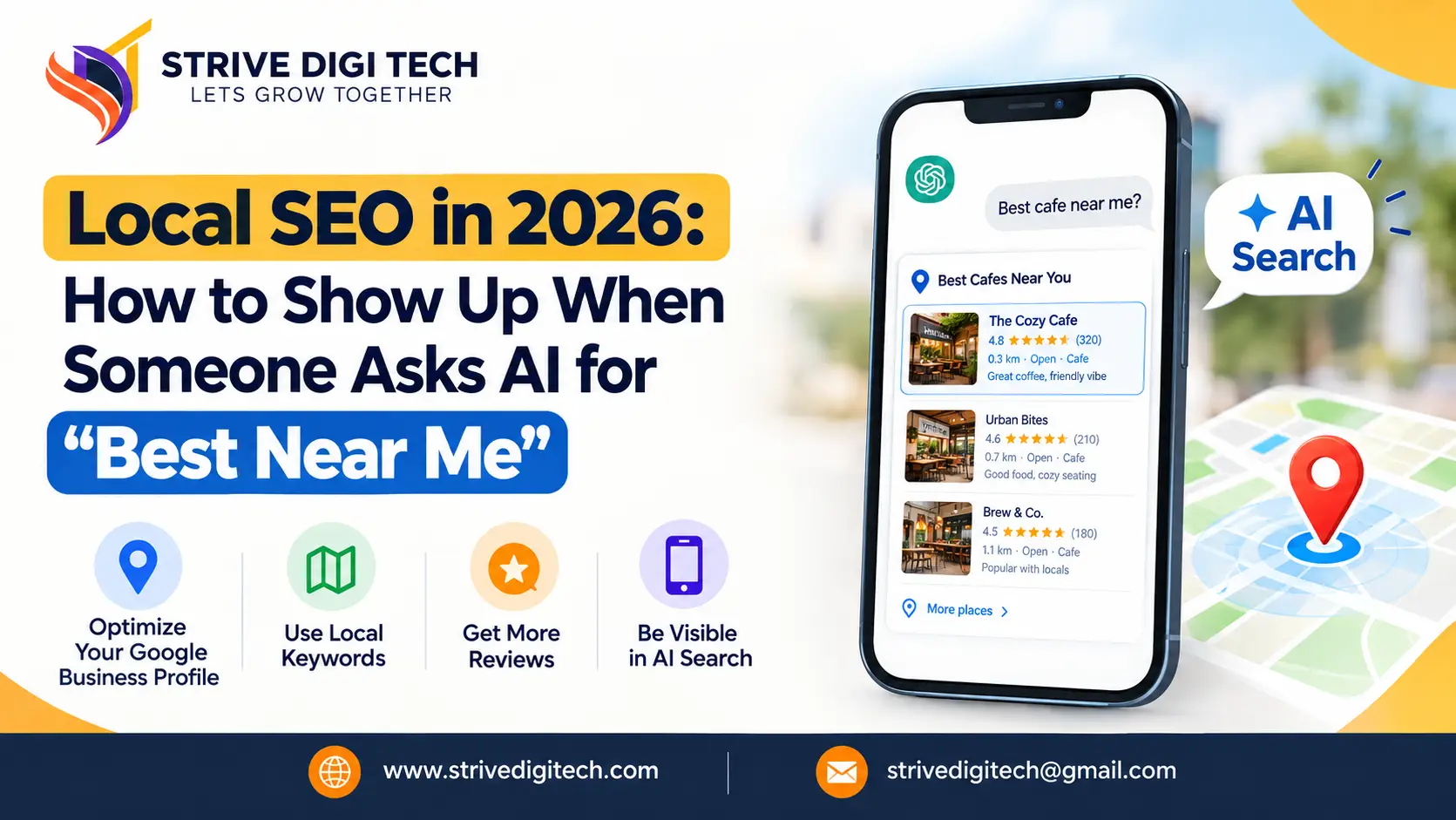
Local SEO in 2026: How to Show Up When Someone Asks AI for "Best Near Me"
When customers ask ChatGPT, Gemini or Google for the best business near them, AI tools name only two or three options. Here is how those tools pick local businesses and the practical steps that get yours on the shortlist.
"Best dentist near me open on Saturday." "Good Indian restaurant near Union Square for a group of eight." "Reliable roofer in Leeds who does free quotes." People have typed searches like these into Google for years. What has changed is where they ask them. More customers now put the same question to ChatGPT, Gemini, Siri, Alexa, Perplexity or Google's AI Overviews, and they get back a short list of two or three names instead of a page of ten blue links.
If your business is not one of those names, you are not on the shortlist at all. This guide explains how AI assistants pick local businesses, what still carries over from traditional local SEO, and the practical steps that make your business easier for AI tools to find, trust and recommend.
How do AI assistants decide which local businesses to recommend?
Short answer: AI assistants build local recommendations from the information they can find and trust: your Google Business Profile and other map listings, reviews, your website, directory listings, local news and social mentions. Businesses with complete, consistent details, strong recent reviews and clear service information on their website are the ones most likely to be named.
No AI company publishes its exact local ranking method. But based on how these tools describe their sources and what we see when testing client queries, recommendations tend to draw on a mix of:
- Map and business listing data such as Google Business Profile, Bing Places and Apple Business Connect
- Review content, not just star ratings but what reviewers actually say
- Your own website, especially service pages, location pages and FAQs
- Third-party sources such as directories, industry associations, local press and "best of" lists
- Consistency of your name, address, phone, hours and services across all of the above
Google itself has long described local ranking in terms of three factors: relevance, distance and prominence. Those three ideas still explain most of what AI assistants do. They just read more sources and summarize them in plain language.
Is local SEO still important if people use AI to search?
Yes, more than before. AI tools do not invent local businesses. They pull from the same listings, reviews and websites that traditional local SEO has always worked on. The difference is that an AI answer shows far fewer options. In a classic Google Maps result, the business in sixth place still gets seen. In a conversational answer that names three businesses, number four might as well not exist.
So the fundamentals have not been replaced. The bar for doing them well has gone up.
What is different about "near me" searches in AI tools?
A few things change when the search happens in a chat window or through a voice assistant:
- Queries are longer and more specific. Instead of "plumber London", people ask "Which plumber in North London can come out tonight for a leaking boiler?" Your content needs to answer specifics like availability, service area and job types.
- The answer explains its choice. AI tools often say why they picked a business: "known for fast response times" or "reviewers mention friendly staff." Those phrases usually come from reviews and your own descriptions.
- Follow-up questions are normal. A user might ask "Which of those is cheapest?" or "Do any of them take insurance?" Businesses with clear pricing, policies and FAQs on their site give the tool something to work with.
- Fewer clicks. Some people call or book straight from the answer without visiting your website. Your phone number, booking link and hours need to be correct everywhere.
Step 1: Make your Google Business Profile complete and active
Your Google Business Profile is still the single most important local listing. It feeds Google Maps, local search results and Google's AI features, and its details are copied widely across the web.
- Choose the most accurate primary category, then add relevant secondary categories.
- Fill in every field: services, products, attributes, service areas, opening hours and holiday hours.
- Write a business description that says plainly what you do, who you serve and where.
- Add real photos regularly: your team, premises, vehicles, finished work.
- Use the Q&A and posts features to answer common questions and share updates.
- Keep holiday hours and temporary closures up to date. An AI tool sending someone to a closed shop damages trust fast.
If you have not touched your profile in a year, start here. Our Google Business Profile optimization work usually begins with exactly this kind of clean-up, because everything else builds on it.
Step 2: Do not ignore Bing Places and Apple Business Connect
Many businesses only manage Google. That leaves gaps. Microsoft's Copilot draws on Bing's data, and Apple Maps data feeds Siri and Apple devices. Some AI tools also use Bing's search index or other map data partners behind the scenes.
Claiming and completing your Bing Places and Apple Business Connect listings takes an afternoon. Bing Places can even import your details from Google. It is one of the quickest wins in local AI visibility, and most of your competitors have not done it.
Step 3: Keep your NAP and service details consistent everywhere
NAP stands for name, address and phone number. If your business is listed as "Smith & Sons Plumbing" on Google, "Smith and Sons Ltd" on Yelp and "Smiths Plumbing Services" on your website, with two different phone numbers, systems have to guess whether these are the same business. AI tools tend to be cautious when information conflicts.
Make a simple list of every place your business appears: Google, Bing, Apple, Yelp, Facebook, industry directories, chamber of commerce, local listings sites. Then make the details match exactly, including suite numbers and formatting. Add your services and service areas consistently too, not just the basics.
Step 4: Build reviews that describe what you do
Reviews matter for two reasons in AI search. The number and rating matter, as they always have. But the words inside reviews matter more than before, because AI tools read them and use them to describe you.
A review that says "Great service, 5 stars" helps a little. A review that says "They fixed our boiler the same evening and explained the cost before starting" tells an AI tool you offer same-day boiler repair with clear pricing. That is exactly the kind of detail it can repeat when someone asks for a fast, honest boiler repair service.
To get more of the useful kind:
- Ask every happy customer, at the moment they are happiest, with a direct link.
- Gently prompt for detail: "If you can, mention what we helped with."
- Never offer incentives for reviews or write fake ones. Google, the FTC in the US and the CMA in the UK all treat fake reviews seriously.
- Reply to every review, positive and negative, briefly and professionally. Replies show the business is active and cares.
- Collect reviews on more than one platform so your reputation does not depend on a single source.
Step 5: Give your website clear local service pages
Your website is where you control the details. AI tools use it to understand exactly what you offer, where and for whom. A single "Services" page with a list of bullet points does not give them much.
Strong local service pages usually include:
- One page per main service, written for real customers
- The areas you cover, named clearly
- What the service includes, typical timeframes and price ranges where possible
- Who does the work, with photos and qualifications
- Reviews or short case examples relevant to that service
- A FAQ section answering real customer questions
- A clear way to call, book or request a quote
If you serve several towns, create location pages only where you have something real to say about each one, such as jobs done there, local team members or area-specific information. Hundreds of near-identical city pages with the name swapped out are a known spam pattern and can hurt you. Well-built location landing pages that convert do the opposite: they give both visitors and AI tools a specific reason to choose you in that area.
Step 6: Add LocalBusiness schema to your website
Schema markup is hidden code that labels your business details for machines: business type, address, phone, opening hours, service area and links to your profiles. It makes your website's information easier for Google, Bing and AI systems to read correctly and match with your listings.
Use the most specific type available, such as Dentist, Plumber, LegalService or RealEstateAgent, rather than a generic LocalBusiness. If you are new to this, our guide to LocalBusiness schema explained walks through what to add and how to test it.
Step 7: Answer conversational questions on your site
Look at how people actually ask for your service. Your sales calls, enquiry emails, Google Search Console data and the "People also ask" box are full of real questions:
- "Do you do emergency call-outs on weekends?"
- "How much does a teeth cleaning cost without insurance?"
- "Do you cover the whole of Greater Manchester?"
- "How long does a kitchen renovation take?"
Answer these directly on your service pages and FAQ, in plain language, with the answer in the first sentence. AI assistants are built to answer questions. A page that already contains a clear answer is an easy source to use.
Step 8: Earn local mentions beyond your own channels
Prominence, in Google's terms, is about how well known you are. AI tools judge this partly by how often trusted sources mention you. Useful places to be mentioned include:
- Local news sites and community blogs
- Industry associations and certification bodies
- Local "best of" lists and award pages
- Supplier or partner websites
- Sponsorships of local events, teams or charities
- Podcasts or interviews with local media
These mentions build the wider picture of your business that AI tools draw on, and they often bring direct referrals as well.
Can AI tools actually read your website?
This sounds basic, but we find problems here more often than you would expect. Some websites block AI crawlers in their robots.txt file, sometimes on purpose and sometimes because a security plugin or hosting setting did it automatically. Others load their key content, such as service lists, prices or opening hours, only through JavaScript widgets that some crawlers do not run.
Check three things with your developer. First, does your robots.txt allow the main AI crawlers, such as OAI-SearchBot and GPTBot from OpenAI, PerplexityBot, and Google's and Bing's crawlers? You can choose which ones to allow, but make it a decision rather than an accident. Second, is your important text in the page HTML itself? Third, does the site load quickly on mobile? A page that times out for a crawler is a page that cannot be quoted.
A 90-day plan for local AI visibility
Here is a realistic order of work for a single-location business that is starting from an average position.
Days 1 to 30: fix the foundations
- Claim and complete Google Business Profile, Bing Places and Apple Business Connect.
- Audit your top 15 to 20 listings and make name, address, phone and hours identical.
- Check robots.txt and make sure key content is crawlable.
- Run your first AI visibility test and save the answers as a baseline.
Days 31 to 60: strengthen your website
- Rewrite or create one page per main service, with service areas, price ranges and FAQs.
- Add the most specific LocalBusiness schema type plus Service schema.
- Set up a simple review request process and ask every satisfied customer.
- Add text versions of menus, price lists or anything currently shown only as an image.
Days 61 to 90: build prominence
- Reach out for two or three local mentions: a partner site, an association listing, a local news story or event sponsorship.
- Publish one or two helpful articles that answer the questions customers ask most.
- Run the AI visibility test again and compare it with your baseline.
- Review call tracking and enquiry data to see which changes are bringing in business.
Multi-location businesses follow the same order, but should repeat the listing and page work for each location and keep a central record of every location's details.
Traditional local SEO vs local AI visibility: what is the difference?
| Area | Traditional local SEO focus | What AI search adds |
|---|---|---|
| Listings | Google Business Profile | Bing Places, Apple Business Connect and consistency across all of them |
| Reviews | Star rating and review count | Detailed review text that describes services and experience |
| Website | Keywords on service and location pages | Direct answers to specific, conversational questions |
| Results shown | Map pack of three plus organic listings | Often only two or three named businesses, with reasons |
| Technical | Mobile speed, basic schema | Detailed schema, crawl access for AI bots, clean HTML |
| Authority | Local backlinks and citations | Mentions in sources AI tools trust and quote |
| Conversion | Website visit, then call | Direct calls and bookings from the answer itself |
How to check whether AI tools recommend your business
You can run a simple test in about 20 minutes each month:
- Write down five to ten questions a real customer would ask, such as "best [service] in [your area]" or "[service] near [landmark] open now".
- Ask each question in ChatGPT, Gemini, Perplexity, Copilot and Google (check whether an AI Overview appears).
- Note which businesses are named, and whether you are one of them.
- Read the reasons given for each recommendation. They tell you what the tool values.
- Check whether any details about your business are wrong, such as old hours or a closed location.
Results vary by location, device and even between runs of the same question, so look for patterns over a few months rather than reacting to one answer. If competitors keep being named for reasons like "many reviews mention quick turnaround", you know what to work on.
Local AI search tips for specific industries
Healthcare and dental clinics
Patients ask detailed questions about insurance, treatments, emergency availability and languages spoken. Answer these on your site, list each practitioner with qualifications, and keep hours exact. Our healthcare marketing for local clinics focuses heavily on this kind of trust information.
Home services
Plumbers, electricians, roofers and cleaners win on service area clarity, response times and reviews that mention specific jobs. Photos of real work help both people and AI tools.
Restaurants and hospitality
Menus in text (not just PDFs or images), dietary options, booking links, group capacity and atmosphere details all feed the questions people ask AI tools when choosing where to eat.
Real estate
Neighbourhood guides, recent sales information and agent profiles help you appear when buyers ask AI tools about specific areas. For property businesses, our approach to real estate lead generation builds this content alongside listings and ads.
Professional services
Lawyers, accountants and consultants should show credentials, practice areas, fee structures where possible and clear author bios on their content.
Common local SEO mistakes that keep you out of AI answers
- An unclaimed or half-finished Google Business Profile
- Different phone numbers or business names across listings
- No listing on Bing Places or Apple Business Connect
- Few recent reviews, or reviews with no detail
- A website with one generic services page and no service areas
- Menus, prices or hours only shown as images or PDFs
- Blocking AI crawlers in robots.txt without realizing it
- Copy-paste city pages with no real local information
Turning AI visibility into calls and bookings
Being named by an AI tool is only useful if it leads to a phone call, booking or quote request. Make the path short:
- Use a tracked phone number on your Google Business Profile and website so you can see which calls come from local search.
- Add an online booking or quote link to your listings.
- Make the first screen of each service page show your phone number and a clear next step.
- Reply to enquiries fast. AI-referred customers have often already shortlisted you, and speed of reply can decide who gets the job.
For the fundamentals of map rankings, see our earlier guide to ranking in the Google Maps 3-pack. This article builds on that foundation for AI assistants.
Where to start
If all of this feels like a lot, start with the three steps that move the needle fastest: complete your Google Business Profile, fix inconsistent listings, and build a steady flow of detailed reviews. Then improve your service pages and schema.
If you would rather have experts handle it, you can hire a local SEO agency for service businesses that already works on AI visibility. Or start smaller: get a local AI visibility check from our team, and we will show you how ChatGPT, Gemini and Google currently describe your business and what to fix first.
Frequently asked questions
How do I get my business recommended by ChatGPT for "near me" searches?
Make sure your business details are complete and consistent on Google Business Profile, Bing Places, Apple Business Connect and major directories. Build detailed reviews, create clear service and location pages on your website, add LocalBusiness schema and answer common customer questions directly.
Does Google Business Profile affect AI search results?
Yes. Google Business Profile data feeds Google Maps, local results and Google's AI features, and its details are widely copied across the web. A complete, accurate profile is the foundation of local AI visibility.
Do reviews matter for AI recommendations?
Yes. AI tools often read review text to describe businesses and explain why they recommend them. Reviews that mention specific services and experiences are especially useful.
Should I create a page for every city I serve?
Only where you have real, unique information for that location. Many near-identical city pages are treated as low-quality content and can hurt your site.
How long does it take to appear in AI local recommendations?
It varies by competition and starting point. Listing and consistency fixes can show effects within weeks, while review growth and authority building usually take a few months.
Is voice search the same as AI search for local businesses?
They overlap. Voice assistants like Siri, Alexa and Google Assistant increasingly use AI to answer questions, and they rely on the same map listings, reviews and website information.