Blog Details
Where Creative Sparks Ignite Branding Revolutions.
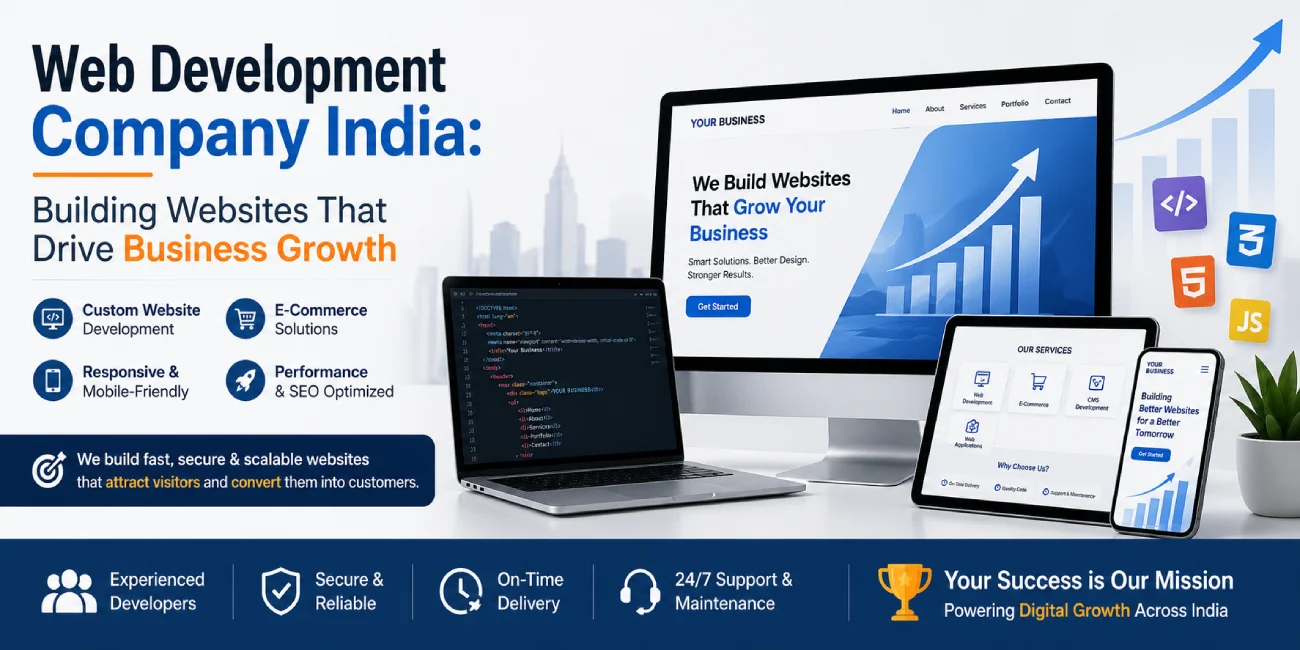
Web Development Services in India: Building Websites That Convert Visitors into Customers
Your website is not just a digital brochure — it is your most powerful sales tool, operating 24/7, reaching prospects you could never reach through traditional marketing, and forming the first impression your brand makes on most new customers. A poorly built website can destroy credibility and drive visitors to competitors within seconds. A superbly built website can become your primary source of qualified leads and revenue.
Introduction: Your Website Is Your Most Important Digital Asset
Your website serves a purpose that goes far beyond simply having an online presence. It's your sales team working 24/7. It's your credibility statement to potential customers. It's how people decide whether to trust your business. In many ways, your website is more important than your physical office location.
Yet many businesses treat web development as a commodity—getting the cheapest quote, picking the first agency that responds, or using a template that a thousand other websites are also using. Then they wonder why their website doesn't generate leads or why visitors leave in seconds.
Choosing the right web development approach is therefore one of the most consequential business decisions you'll make. This guide explains what separates a website that actually generates business from one that simply exists online.
Understanding Website Types: Matching Technology to Business Objectives
Not all websites serve the same purpose. The technology and approach that works for a corporate branding site is entirely different from what you need for an e-commerce platform. Understanding which type you need determines everything—cost, timeline, and expected returns.
Corporate and Business Websites
Your corporate website is your digital storefront. It's where potential clients go to understand who you are, what you do, and whether they should trust you. The best corporate websites establish credibility, clearly communicate your unique value proposition, and convert interested visitors into qualified enquiries.
A high-performing corporate website accomplishes several things simultaneously:
- Ranks for relevant search terms so potential clients find you organically
- Loads in under 2 seconds, keeping visitors engaged instead of losing them to bounce
- Works flawlessly on mobile devices where 85%+ of your visitors will arrive
- Clearly presents your differentiators so visitors understand why they should choose you
Corporate websites typically range from 10-30 pages and require professional copywriting, photography, and design—not templates.
E-Commerce Platforms and Online Stores
E-commerce websites operate under different constraints than corporate sites. You're not just presenting information—you're managing complex operations: product catalogs with thousands of SKUs, inventory tracking, multiple payment methods, shipping integrations, customer accounts, and return management.
A well-built e-commerce platform requires:
- Sophisticated search and filtering so customers find products quickly
- Optimized checkout flows that minimize cart abandonment
- Integration with payment gateways (Razorpay, PayU, multiple credit cards)
- Real-time inventory management to prevent overselling
- Shipping and logistics integration for order fulfillment
We build e-commerce platforms using WooCommerce for WordPress-based shops, Shopify for businesses wanting a fully managed solution, and custom frameworks for complex, high-volume operations.
Explore e-commerce website development →
High-Converting Landing Pages
A landing page is a single-purpose webpage designed to convert a specific audience segment. Unlike your corporate site (which serves multiple audiences), a landing page is laser-focused on one goal: turning a particular type of visitor into a lead or sale.
Landing pages are essential when you're running paid traffic campaigns (Google Ads, Facebook ads, LinkedIn ads). Research consistently shows that landing pages with focused messaging convert 2-5x better than sending paid traffic to your generic homepage. The message on your landing page matches the ad that brought the visitor there, and the call-to-action is crystal clear.
Effective landing pages have:
- A single, clear value proposition matched to the visitor's intent
- Minimal navigation (no header menu trying to send visitors elsewhere)
- A prominent call-to-action that stands out visually
- Trust signals like client logos, testimonials, or credentials
For businesses running paid traffic campaigns, well-designed landing pages often deliver 3x better ROI than generic homepage traffic.
Content Management System Websites
Many businesses produce regular content—blog articles, news updates, case studies, or resource libraries. Manually updating a hardcoded website every time you publish something new is impractical. A CMS-powered website allows non-technical team members to create, edit, and publish content without needing developer assistance.
WordPress is the most popular CMS globally, powering over 40% of all websites. We also work with Joomla and Drupal for organizations requiring more complex workflows or enterprise features.
A CMS website makes sense when:
- You publish content regularly and want your team managing it directly
- You need SEO performance and content is your primary growth channel
- You want flexibility to extend functionality through plugins and integrations
Custom Web Applications
Not every business need fits into a standard website template. Some businesses require custom-built web applications: booking systems where customers reserve services and pay online, customer portals where clients access their accounts, inventory management systems connecting to retail operations, or multi-vendor marketplaces where third-party sellers operate independently.
Custom web applications require more sophisticated development but deliver competitive advantages that off-the-shelf solutions can't provide. We build scalable, secure web applications from the ground up, designed specifically for your business logic and technical requirements.
Learn about custom software development →
The Seven Non-Negotiable Elements of a High-Performing Website
Regardless of website type, certain fundamentals separate websites that generate business from websites that merely exist. These aren't optional—they're baseline requirements in 2024.
1. Mobile Responsiveness
Over 85% of Indian internet users access the web exclusively through smartphones. Google's search algorithm now indexes websites primarily on their mobile version. A website that doesn't work perfectly on smartphones doesn't just provide a poor user experience—it's penalized by search engines and it's losing the majority of your potential customers.
Mobile responsiveness isn't an afterthought or an enhancement. It's the foundation. Every website we build is designed mobile-first, with desktop as an extension rather than the primary focus.
2. Page Speed
Slow websites lose customers. Research shows that 53% of mobile visitors abandon a website that takes more than 3 seconds to load. Beyond user experience, page speed is a direct ranking factor for Google—slower sites rank lower in search results.
We optimize every website for sub-2-second load times using:
- Code minification to remove unnecessary characters
- Image compression and modern formats (WebP) to reduce file sizes
- Content Delivery Networks (CDN) to serve content from geographically closer servers
- Server-side caching to reduce database queries
A website that loads in 2 seconds vs. 5 seconds might not sound like much, but the difference in conversion rates is typically 20-30%.
3. SEO Foundation
Many websites are built first, then SEO is bolted on as an afterthought—usually through an expensive consulting engagement that reveals structural problems that could have been prevented. A website built without SEO in mind requires costly retrofitting.
We build SEO foundations into every website from day one:
- Clean URL structures that communicate page purpose (example.com/services/web-design vs. example.com/?p=123)
- Proper heading hierarchies (H1, H2, H3) that structure content logically
- Schema markup so search engines understand your content (local business schema, product schema, organization schema)
- XML sitemaps and robots.txt so search engines can index your content effectively
A website with strong SEO foundations will rank better, require less SEO spend, and drive more organic traffic over time.
Learn about our SEO services →
4. User Experience Design
Beautiful design matters, but beautiful design without functional user experience is just decoration. The best websites look great AND make it easy for visitors to find what they're looking for and take action.
Effective UX design considers:
- Intuitive navigation so visitors understand site structure immediately
- Clear visual hierarchy so important elements stand out
- Strategic use of white space so pages don't feel overwhelming
- Prominent calls-to-action that guide visitors toward conversion
How long a visitor stays on your site and whether they convert is directly determined by UX quality.
Explore our UI/UX design services →
5. Security and Trust Signals
HTTPS (SSL certificates) is non-negotiable. Not only does Google flag non-HTTPS sites as "Not Secure" in Chrome browsers, but HTTPS is also a direct ranking factor. Beyond technical security, websites need to communicate trustworthiness to visitors.
All Strive DigiTech websites come with SSL certificates installed and configured. Additionally, we recommend and implement trust signals throughout your website—client logos, testimonials from real customers, professional certifications, years of operation, and transparent business information.
6. Analytics and Tracking
Without tracking, a website is guesswork. You're making decisions based on assumptions rather than data. We integrate robust analytics into every website we build:
- Google Analytics 4 to understand visitor behavior, traffic sources, and conversion patterns
- Google Search Console to monitor search performance and identify ranking opportunities
- Heat mapping tools (where applicable) to see where visitors click and how they interact with pages
Analytics data drives optimization decisions. You can see what's working, what isn't, and where improvements will have the biggest impact.
7. Conversion Optimization
Traffic without conversion is wasted. A website that gets 10,000 monthly visitors but generates zero leads is no better than a website getting 100 visitors. Conversion optimization means strategically designing your website to turn visitors into customers.
We build conversion-focused websites by:
- Placing strategic CTAs (calls-to-action) prominently on every page
- Displaying trust signals (client logos, testimonials, certifications) to reduce visitor hesitation
- Creating lead capture forms that ask the right questions without being invasive
- Integrating WhatsApp chat so visitors can reach you immediately
- Implementing enquiry tracking so you understand your conversion funnel
A 2% improvement in conversion rate often translates to 20%+ increase in revenue when you're already running paid traffic.
Our Web Development Technology Stack
The technologies we choose aren't based on trend—they're based on what works best for your specific needs. We use modern, well-supported technologies that will be maintainable and scalable for years to come.
Technology Breakdown
Frontend: HTML5, CSS3, JavaScript, React, Vue.js, Next.js
Backend: PHP, Node.js, Python, Laravel
E-Commerce: WooCommerce, Shopify, Magento, Custom Frameworks
Content Management: WordPress, Joomla, Drupal
Database: MySQL, PostgreSQL, MongoDB
Hosting: AWS, Google Cloud, Optimized cPanel Hosting
We don't use outdated technologies. We don't force a one-size-fits-all solution. We choose the right tool for your specific needs, considering maintainability, scalability, and long-term cost of ownership.
Our Web Development Process: From Discovery to Launch and Beyond
Professional web development follows a structured process. We don't jump immediately into coding. Each phase builds on previous work and ensures you're not paying for rework later.
Discovery Phase
We start by understanding your business, your goals, your target audience, and your technical requirements. This phase involves detailed conversations about your business model, competitive landscape, and success metrics. A clear discovery phase prevents wasted effort later.
Wireframing and Structure
Before designing anything visually, we create wireframes—structural layouts that define page structure and information hierarchy. This prevents the common situation where a beautiful design doesn't work practically because the information flow wasn't thought through first.
UI/UX Design
Visual mockups are created in Figma with full client approval before a single line of code is written. This ensures you can see and approve the design direction before development begins. Changes at the design phase are quick and inexpensive. Changes after development has started are expensive.
Development
Our developers write clean, well-commented code following industry best practices. Code isn't just written for functionality—it's written so that future developers (including you, or someone else, a year from now) can understand it.
Testing
We test across browsers (Chrome, Firefox, Safari, Edge), devices (desktops, tablets, phones), and performance conditions. A website that works on one browser but breaks in another damages your credibility.
Launch and Setup
Launching isn't just uploading files to a server. It includes configuring SSL certificates, setting up analytics tracking, configuring search engine tools, testing form submissions, and ensuring everything works in production. We coordinate the launch carefully to minimize issues.
Post-Launch Support
Launch day is the beginning, not the end. We provide ongoing maintenance, security updates, and performance monitoring. If issues arise post-launch, we respond quickly. Regular updates keep your website secure and ensure it continues performing well.
Choosing the Right Web Development Partner
Not all web development companies are equal. Here's what to look for:
Proven Experience
Ask for a portfolio of actual work. A company should be able to show you completed projects similar to what you need. Check whether those websites actually rank in search engines, load quickly, and convert visitors.
Understanding of Business Objectives
A good development partner doesn't just ask "what features do you want?" They ask "what business problem are we solving? How will success be measured?" They think about business outcomes, not just technical features.
Technical Excellence
The code matters. Poor code leads to slow websites, security vulnerabilities, and difficulty making changes later. A good development partner writes code that's not just functional but maintainable.
Commitment to Standards
Web standards exist for a reason. A partner committed to WCAG accessibility standards, SEO best practices, and security standards will build you a website that serves all users and works for years to come.
Post-Launch Support
Support doesn't end at launch. Your development partner should offer ongoing maintenance, updates, and optimization. A website needs continuous care to remain secure, fast, and effective.
Building Your Next Website: Key Takeaways
Your website is not just an online presence—it's a sales tool, a credibility statement, and often your most important customer touchpoint. A well-built website drives business growth. A poorly built website costs you money by failing to convert interested visitors.
The right development approach depends on your specific business needs:
- Corporate websites establish credibility and convert visitors into enquiries
- E-commerce platforms handle the complexity of online retail
- Landing pages maximize conversion from paid traffic
- CMS websites enable your team to manage content
- Custom applications solve unique business problems
Regardless of which approach you choose, certain fundamentals are non-negotiable: mobile responsiveness, fast page speed, SEO foundation, user experience design, security, analytics, and conversion optimization.
If you're considering web development for your business, we'd be happy to discuss your specific needs, answer questions about the right approach, or provide a detailed proposal and timeline.
Ready to Build a Website That Generates Business?
Explore our web development services →
View our portfolio of completed websites →
Schedule a free consultation and website audit →
Key Statistics
- 85%+ of Indian users access web exclusively on mobile devices
- 53% of mobile users abandon sites taking >3 seconds to load
- Landing pages with focused messaging convert 2-5x better than homepages
- HTTPS is a direct Google ranking factor
- 40% of all websites use WordPress
- Mobile-first indexing is now Google's standard approach
- Web speed improvements of 2 seconds can improve conversion rates by 20-30%