Blog Details
Where Creative Sparks Ignite Branding Revolutions.
The Rise of Super Apps in 2026: Why the Future of Mobile Is One App That Does Everything
Ready to explore super app strategies for your business? Contact Strive DigiTech for a free consultation.
Look at the home screen of any smartphone in India right now. There is a messaging app, a payments app, a food delivery app, a ride-hailing app, a shopping app, and a banking app — each one siloed, each one requiring its own login, its own profile, its own navigation logic. The average Indian smartphone user has over 30 apps installed. Most of them overlap in purpose. Many of them are rarely opened.
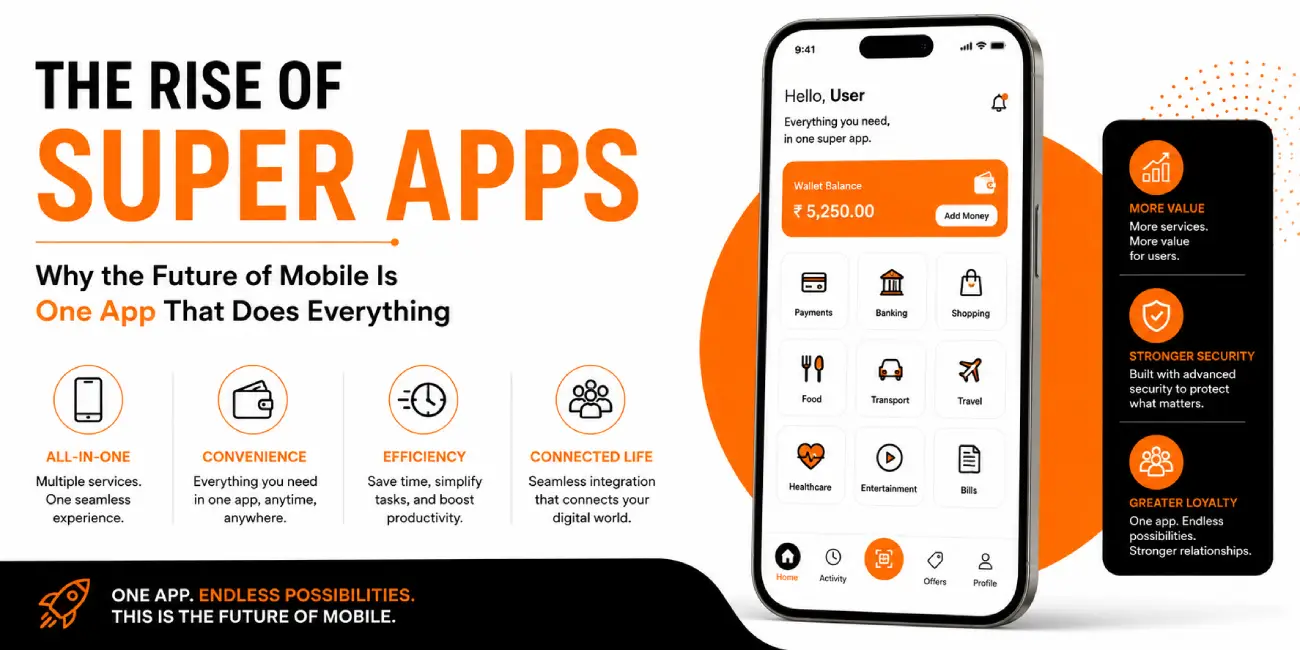
The super app is the answer to this fragmentation. Not just a trend, and not just a product category — it is a fundamentally different philosophy for how mobile software should be designed. Instead of asking users to manage a collection of disconnected tools, a super app brings everything under a single roof: one identity, one wallet, one experience.
In 2026, this model is no longer an experiment confined to Asia. It is the strategic direction that banks, telecoms, retail giants, and ambitious technology startups across the world are moving toward. For any business investing in mobile app development today, understanding the super app shift is not optional — it is foundational.
What Is a Super App? A Clear Definition
A super app is a mobile platform that integrates multiple distinct services — typically spanning messaging, payments, shopping, food delivery, financial products, transportation, and more — into a single, unified application. The user never needs to leave the platform to move between completely different tasks.
This is more than a feature list. The four structural characteristics that define a genuine super app are:
- A unified identity layer — One login, one profile, and one payment method that work seamlessly across every service within the platform. The user authenticates once and never thinks about it again.
- Mini apps or embedded services — Third-party services that run as lightweight modules inside the host platform, rather than requiring separate downloads. Users access new services without leaving the ecosystem.
- A data flywheel — Every service a user engages with deepens the platform’s understanding of that user. The more data accumulated across categories, the more precisely the platform can personalise every interaction — creating a feedback loop that strengthens over time.
- Network effects — Each new service added to the ecosystem makes the platform more valuable to every existing user. More users attract more service providers, which attracts more users. The platform grows stronger as it grows larger.
Super apps are less a trend and more a survival strategy. Users expect convenience, and platforms that deliver it become ecosystems instead of apps.
The Global Super App Moment: From Asia to Everywhere
Asia’s Proven Blueprint
The super app model was proven at scale in Asia long before the rest of the world took it seriously. WeChat, with over 1.3 billion active users, is the clearest example of what a fully mature super app looks like in practice. Chinese users rely on it to message, pay bills, order food, invest money, book doctors, play games, and manage business operations — all without switching apps. Grab in Southeast Asia followed a parallel path, beginning as a ride-hailing service before evolving into a comprehensive platform covering food delivery, financial services, and healthcare.
What these platforms demonstrated is not just technical feasibility. They proved something more important: users will willingly consolidate their digital lives into a single trusted platform, provided that platform genuinely delivers value across each service it offers. Convenience, once experienced at this depth, is nearly impossible to give up.
The Western Inflection Point
Western markets were initially resistant. Regulatory environments were stricter, and single-purpose apps had built deeply entrenched user habits. But 2026 represents a clear turning point. The moves being made now across Western markets include:
- Financial super apps — Major banks and fintech platforms embedding lifestyle services — shopping rewards, travel booking, insurance, investment products — directly into their banking interfaces.
- Messaging platforms expanding into commerce — Platforms with hundreds of millions of existing users adding payment layers and marketplace functionality, monetising attention they already captured.
- Retail apps becoming ecosystems — Large retailers adding delivery services, financial products, and loyalty ecosystems that function as early-stage super apps for their customer base.
- Telecoms as super app operators — Mobile network operators — who already hold billing relationships and identity infrastructure for tens of millions of customers — quietly building multi-service platforms on top of existing relationships.
Why Super Apps Win: The Business Case in Plain Terms
Drastically Lower Customer Acquisition Costs
Acquiring a new app user in a competitive category is expensive. In India, paid user acquisition costs across sectors like fintech, e-commerce, and food delivery can run to hundreds of rupees per install — and that cost continues to rise as app store competition intensifies.
Super apps change the unit economics entirely. Once a user is acquired for one service, introducing them to a second service within the same platform costs a fraction of standalone acquisition. The messaging feature acquires the user. The payments feature monetises them. The shopping feature generates revenue. The food delivery feature increases daily active usage. Each service makes the others more valuable.
Higher Lifetime Value Through Deeper Engagement
Users who engage with three or more services within a single platform have dramatically higher lifetime value than those who use only one. They are more active, less likely to churn, more responsive to relevant offers, and more forgiving of occasional service failures because the switching cost — abandoning an entire ecosystem rather than just one app — is far higher.
The Data Advantage That Compounds Over Time
A payments app knows what you spend. A messaging app knows who you communicate with. A shopping app knows what you want to buy. A super app that integrates all three knows you in a way that no single-service competitor can replicate — and that advantage grows with every interaction. Used responsibly and transparently, this data depth enables personalisation, fraud prevention, credit assessment, and marketing precision that constitutes a genuine and durable competitive moat.
The Mini App Architecture: How Super Apps Are Built Technically
The technical foundation of most production super apps is a mini app architecture. Rather than building every service as a full native module, the host platform provides a runtime environment that allows third-party developers to build lightweight mini apps — sandboxed experiences that run inside the super app without requiring separate downloads or installations.
For the operator, this creates a platform business model. The operator provides infrastructure — identity, payments, distribution, data — and service providers build on top of it. The operator captures a revenue share; the service providers get direct access to an existing, engaged user base. This model requires deep expertise in custom software development to build correctly and sustainably.
Building a super app architecture from the ground up requires five core components:
- A robust identity and authentication layer — Single sign-on that works seamlessly across all embedded services, with security infrastructure that meets financial-grade standards.
- A unified payments infrastructure — Support for UPI, cards, wallets, BNPL, and other payment methods, with a single transaction ledger that spans all services.
- A mini app runtime environment — A sandboxed execution context that enforces security boundaries between services while allowing sufficient functionality for third-party developers to build compelling experiences.
- Developer tools and documentation — The quality of the developer ecosystem determines how quickly third-party service providers adopt the platform. Poor tooling creates a thin marketplace; great tooling creates a thriving one.
- A contextual discovery and recommendation engine — The intelligence layer that surfaces relevant mini apps to the right user at the right moment, based on behaviour, location, time, and transaction history.
The UI/UX design of a super app is equally critical. More services do not automatically create a better experience. The most successful super apps invest heavily in ensuring the unified experience genuinely feels unified — not like a collection of separate products awkwardly stitched together under one icon.
Challenges Every Super App Builder Must Navigate
Regulatory Complexity
Super apps aggregate sensitive data across financial, health, and communication services simultaneously. This intersection attracts scrutiny from multiple regulatory bodies — data protection authorities, financial services regulators, and competition watchdogs — whose requirements do not always align with each other. Businesses building super app platforms in 2026 need legal and compliance expertise embedded in the product team from the very first architecture decision, not retrofitted after launch.
Trust and Privacy as Product Requirements
The data flywheel that makes super apps powerful is the same thing that makes users nervous about them. Building genuine user trust requires transparent data practices, meaningful consent mechanisms, clear communication about how data is used, and demonstrable security infrastructure. Super apps that handle user data carelessly will face regulatory consequences — and, more immediately, the user abandonment that precedes them.
The UX Challenge of Managing Complexity
Adding more services to a platform does not automatically make it better. Super apps that overwhelm users with choices, bury core functionality under layers of navigation, or feel incoherent across their different sections will struggle to retain users regardless of how technically capable they are. World-class UI/UX design services are not a nice-to-have for super app development — they are what separates platforms users love from platforms users abandon.
What Should Businesses Do Right Now?
Not every business needs to build a full super app from scratch. The smarter question is: where does your business fit in the ecosystem that super apps are creating? There are three distinct strategic positions:
- Become a platform operator — Build the super app and create an ecosystem of services around it. This requires significant capital and deep technical investment, but the network effects and data advantages it generates are compounding and difficult for competitors to replicate.
- Become a mini app service provider — Build a high-quality mini app that lives inside an established super app platform. This grants access to massive existing user bases without the overhead of building infrastructure from scratch — an attractive model for startups and specialists.
- Add super app elements to an existing product — A retail app adding integrated payments and a loyalty ecosystem, or a banking app embedding lifestyle services, can capture meaningful benefits of the super app model without requiring a complete rebuild. This is the most accessible entry point for most established businesses.
For businesses in India, the opportunity is especially significant. With 600 million Android users, deep UPI adoption, and an increasingly mobile-first consumer base, the infrastructure for super app behaviour already exists. What is still being built is the software layer on top of it. Our mobile app development team works with businesses at all three strategic levels — from full platform architecture to targeted feature additions.
How Strive DigiTech Approaches Super App Development
Building super app features — whether a unified payments layer, a mini app runtime, a multi-service loyalty ecosystem, or a complete platform architecture — requires a rare combination of deep technical expertise and clear-eyed understanding of platform economics. Most development teams can build features. Far fewer can design systems that scale, monetise correctly, and compound in value over time.
At Strive DigiTech, our approach begins with strategy before code. We work with clients to define the right super app model for their specific market position, design the technical architecture that makes it scalable, and build the experiences that make it genuinely worth using. Our custom software development team brings experience across fintech platforms, retail ecosystems, and on-demand service applications — the exact categories that super app architecture most commonly spans.
Every super app also needs a growth engine. A technically excellent platform with no users is just infrastructure. Our digital marketing services team works alongside the development team to build the acquisition, retention, and re-engagement strategies that fill the platform with active users — turning technology investment into measurable business outcomes.
For super apps with an e-commerce or marketplace dimension, our e-commerce development expertise ensures the transactional layer is built for conversion, not just functionality. And for businesses that want to understand how their super app communicates with users across channels, our social media marketing and email marketing services provide the engagement infrastructure to complement in-app communication.
Industries Building Super App Features in India Right Now
Super app development is not confined to technology companies. The businesses moving most aggressively toward the super app model in the Indian market span multiple sectors:
- Fintech and Banking — Digital banks and payment platforms embedding insurance, investment, and lifestyle services. See our startup digital marketing approach for growth strategies relevant to fintech platforms.
- Retail and E-Commerce — Large retailers building loyalty ecosystems, delivery services, and financial products into their shopping apps. Explore our retail marketing solutions.
- Healthcare — Health platforms combining telemedicine, pharmacy delivery, diagnostics, and insurance into unified patient experiences. View our healthcare digital marketing services.
- Travel and Hospitality — Travel apps evolving into lifestyle platforms covering flights, hotels, experiences, and travel finance. Explore our travel and hospitality marketing expertise.
- Education — EdTech platforms bundling courses, tutoring, career services, and financial aid into single student-facing ecosystems. See our education digital marketing services.
Conclusion: The Super App Is Not Coming — It Is Already Here
The super app is not a future scenario businesses can afford to consider later. WeChat has demonstrated it at over a billion users. Grab has proven it across multiple emerging markets. And in 2026, the model is actively being replicated across every major market and industry vertical.
The question for any business with a mobile product is no longer whether super apps will matter. They already do. The question is where your product will sit in the ecosystem they are creating — as an operator building infrastructure, as a service provider building on someone else’s platform, or as an established product adding the features that make it stickier and more valuable.
Each path requires different technical decisions, different investment levels, and different timelines. What they share is urgency. Businesses that begin thinking strategically about this now will have options. Businesses that wait will find the platform positions already occupied. Strive DigiTech’s mobile app development team is ready to help you define your position and start building it.
👉 Talk to Strive DigiTech About Your Super App Strategy — Book a Free Consultation
Published by Strive DigiTech — A leading mobile app development company in India specialising in custom Android, iOS, and cross-platform applications for businesses across every industry.