Blog Details
Where Creative Sparks Ignite Branding Revolutions.
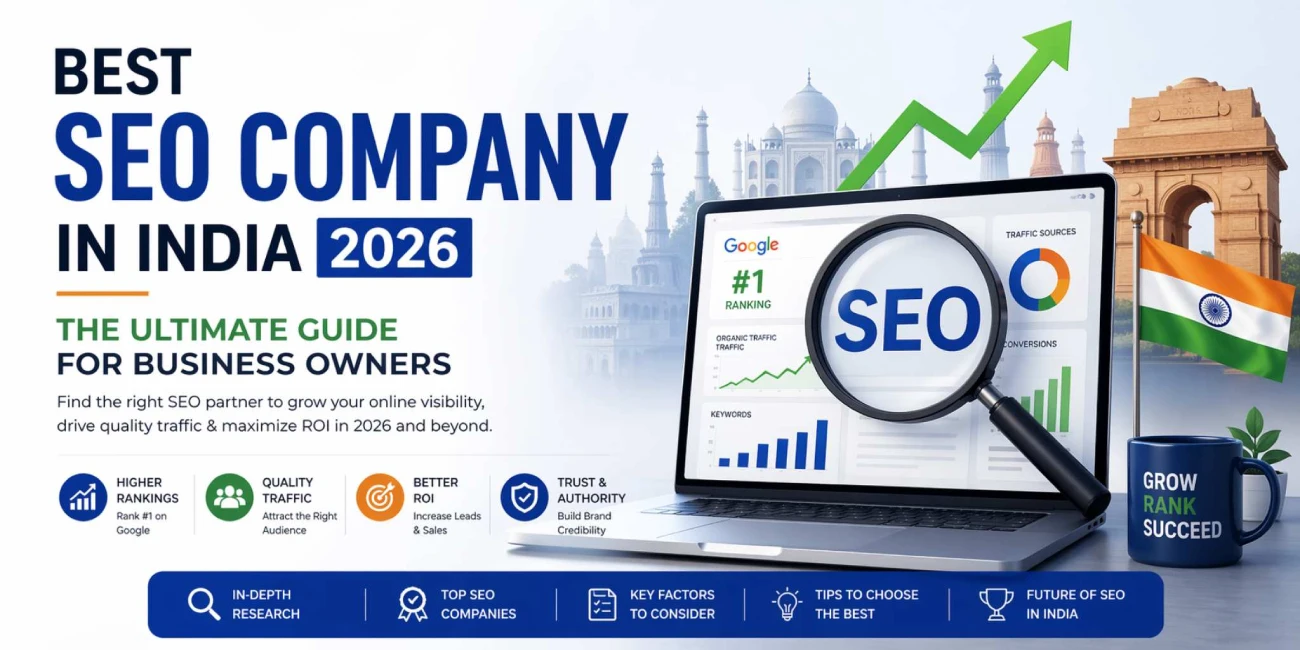
Best SEO Company in India 2026: The Ultimate Guide for Business Owners
India's digital economy is projected to reach $1 trillion by 2030. With over 900 million internet users, the competition for online visibility has never been fiercer. In this landscape, Search Engine Optimisation (SEO) has evolved from a nice-to-have marketing tactic to the single most powerful channel for sustainable, compounding business growth.
There are hundreds of agencies in India claiming to be the best SEO company. Most of them are not lying out of malice — they are repeating claims they believe, because their clients do not yet know enough to challenge them. The result is a market full of confidence and a shortage of accountability.
This guide is written for business owners and marketing leaders who want to cut through that noise. It explains what modern SEO actually involves, what a well-run campaign looks like at each stage, how to evaluate the agencies competing for your budget, and what realistic outcomes look like — not the optimistic projections every agency front-loads into a proposal, but the honest picture of what is achievable and on what timeline.
If you are investing in SEO — or thinking about starting — the information here will help you spend more intelligently and demand more from the people you hire.
📈 Why 2026 is a Pivotal Year for SEO | India's internet user base crossed 900 million in 2025. Search behaviour is shifting: AI-powered answer engines like ChatGPT, Gemini, and Perplexity are now part of how millions of users find information. Businesses with genuinely authoritative, well-structured content are benefiting from both traditional Google rankings and AI-sourced answers. Those relying on thin, keyword-heavy pages are losing ground on both fronts simultaneously. |
1. What SEO Actually Involves in 2026
The version of SEO that most people have encountered — keyword stuffing, spammy backlinks, meta keyword tags — bears almost no resemblance to how effective SEO is practised today. Google's algorithm has evolved through hundreds of major updates over the past decade, and the distance between what worked in 2012 and what works now is significant enough that they are essentially different disciplines.
Modern SEO is built on four interconnected pillars, each of which needs to be functioning well for the others to reach their potential.
Technical SEO: The Foundation Everything Else Rests On
Technical SEO addresses the infrastructure of your website — the elements that determine whether Google can find, understand, and trust your pages. A site with strong content and excellent backlinks but unresolved technical issues will consistently underperform its potential, because the algorithm's ability to access and evaluate the content is limited.
The technical factors that matter most in 2026 include Core Web Vitals — Google's set of page experience metrics covering loading speed, interactivity, and visual stability — alongside mobile-friendliness, HTTPS security, crawl budget management, structured data markup, and canonical URL configuration. None of these are especially glamorous. All of them are consequential.
On-Page SEO: Telling Google What Each Page Is About
On-page SEO is the process of aligning each page of your website with the search intent of the queries you want to rank for. This means more than placing keywords in headings. It means understanding what someone who types a particular query actually wants to find — and building a page that satisfies that intent more completely than any competing page.
Intent varies significantly even among superficially similar queries. Someone searching "SEO services" is in a very different mindset from someone searching "how much do SEO services cost in India" or "is SEO worth it for small businesses." Each of these queries calls for a different page with a different structure, different content depth, and a different call to action.
Off-Page SEO: Building Authority Beyond Your Own Website
Google interprets links from other websites as votes of confidence. A link from a respected publication in your industry signals that people who know the space consider your content worth referencing. The quality of those signals — the authority, relevance, and editorial standards of the sites linking to you — matters far more than the quantity.
Legitimate off-page SEO involves earning links through genuinely useful content, digital PR, strategic partnerships, and original research or data that other publishers want to cite. It does not involve buying links from link farms, participating in link exchange schemes, or any of the other shortcut tactics that carry meaningful penalty risk.
Content Strategy: The Fuel That Drives SEO Performance
Content is not a component of SEO — it is the medium through which SEO operates. Every page that ranks is a piece of content. Every link earned is earned by content that someone found worth referencing. Every featured snippet or AI-generated answer that includes your brand is pulled from content that demonstrated sufficient expertise and clarity.
Effective content strategy for SEO in 2026 is built around demonstrating genuine expertise on topics your target customers care about. This is what Google's E-E-A-T framework (Experience, Expertise, Authoritativeness, and Trustworthiness) is designed to reward — and it is also the characteristic that makes content useful as source material for AI answer engines.
For the full range of how we approach each of these areas: Explore Strive DigiTech's SEO Services.
2. The Honest SEO Timeline: What to Expect, and When
One of the most damaging myths in the SEO industry is the promise of fast results. "Page 1 in 30 days" is either a lie or a signal that dangerous shortcuts are being used. Organic search authority is built gradually, and any agency claiming otherwise is either working on extraordinarily low-competition terms or using tactics that will eventually attract a penalty.
Here is an honest account of what a well-executed SEO campaign typically looks like at each stage, and why the timeline works the way it does.
| Phase | Timeframe | What Is Happening | What You Should See |
| Foundation | Months 1–2 | Technical audit, crawl issue fixes, keyword mapping, on-page optimisation of priority pages | Improved site health scores; initial ranking data establishing a baseline |
| Early Growth | Months 3–4 | Long-tail content publishing begins; link building outreach underway; local SEO if applicable | Rankings appearing for specific, longer queries; organic traffic rising 15–35% |
| Momentum | Months 5–6 | Competitive keywords moving to page 2–3; domain authority increasing; content gaps being filled | Measurable lead flow from organic; primary keywords approaching page 1 |
| Compounding | Months 7–12 | Primary commercial keywords on page 1; content earning backlinks organically; stronger brand signals | Significant organic lead volume; lower cost-per-acquisition than paid channels |
| Long-Term Asset | Year 2+ | Traffic and leads grow without proportional cost increases; SEO becomes most efficient channel | ROI compounds — the same investment produces increasing returns over time |
The timeline above assumes a campaign that is properly resourced, consistently executed, and operating in a competitive but not hyper-competitive market. Highly contested keywords in industries like finance, real estate, or healthcare typically take longer. Local or niche B2B keywords in less crowded markets can move faster. A reputable agency will tell you honestly which category your targets fall into — and will not promise page 1 rankings they cannot substantiate.
3. SEO for the Indian Market: Why Local Context Matters
An agency with strong general SEO credentials is not automatically the right choice for an Indian business. India's search landscape has characteristics that require specific knowledge and experience to navigate effectively.
Mobile-First Is Not a Preference — It Is the Reality
More than 80% of Google searches in India originate from mobile devices. This is not a statistic to acknowledge and move on from — it has direct implications for technical priorities, content format, page speed targets, and user experience decisions. Google's mobile-first indexing means your mobile site is the version the algorithm primarily evaluates. A site that performs well on desktop but slowly on a 4G mobile connection is being evaluated on its weaker version.
Regional Language SEO Is a Genuine Opportunity
Hindi, Tamil, Telugu, Kannada, Bengali, Marathi, and Gujarati searches collectively represent hundreds of millions of queries per month. Most businesses market only in English and compete intensely for a fraction of the available search traffic. The regional language opportunity is large, growing quickly, and significantly less contested than English-language search — meaning businesses willing to invest in vernacular content can achieve faster results at lower cost.
Effective regional language SEO is not translation. It requires understanding how speakers of each language actually search — the colloquial phrases, the regional variations, the conversational constructions that differ significantly from a direct translation of English keywords. Agencies without native language capability frequently get this wrong in ways that are invisible until performance data reveals the gap.
Local SEO for Hyperlocal Intent
Searches like "chartered accountant in Pune" or "digital marketing agency near me in Jaipur" are hyperlocal queries with high commercial intent — the person searching already knows what they want and is looking for someone local to provide it. Capturing this traffic requires Google Business Profile optimisation, consistent local citation building, location-specific landing pages, and review management.
For businesses serving specific cities or regions, local SEO often produces faster and more commercially relevant results than broader national keyword targeting. It is frequently underinvested relative to its impact.
Voice Search and Conversational Queries
India is among the world's fastest-growing voice search markets. Affordable smartphones and improving regional language voice recognition have shifted a meaningful proportion of searches toward spoken queries — which tend to be longer, more conversational, and often phrased as direct questions. Optimising for voice search requires a different approach to keyword selection and content structure than traditional typed-query SEO.
4. SEO and AI Answer Engines: The Dimension Most Agencies Are Missing
Search is no longer only happening on Google. ChatGPT, Google Gemini, Microsoft Copilot, and Perplexity are now part of how millions of users find information, compare options, and make purchase decisions. These platforms pull from structured, authoritative web content to generate their answers — and the businesses whose content they reference are gaining brand visibility in a channel that is growing rapidly.
The good news is that the characteristics that make content rank well on Google are largely the same ones that make it useful to AI answer engines: clear structure, genuine expertise, accurate and specific information, original research or data, and well-attributed claims. The business that invests in genuinely authoritative content is building an asset that performs across both traditional search and the emerging AI-search landscape simultaneously.
The businesses that will be disadvantaged in this environment are those with content that was designed primarily to satisfy an algorithm — keyword density targets met, heading structures present, but no genuine informational depth. Google's algorithms and AI engines alike are increasingly capable of distinguishing between content that exists to help users and content that exists to rank.
💡 What AI-Ready Content Looks Like | Content that surfaces in AI-generated answers tends to share specific qualities: it answers questions directly and specifically; it cites verifiable sources or data; it is organised so that individual sections address distinct questions clearly; and it is produced by or under the supervision of someone with demonstrable expertise in the topic. These are the same qualities that E-E-A-T evaluation rewards in Google's algorithm. |
5. How to Evaluate an SEO Agency in India: The Questions That Matter
Every SEO agency in India will present a proposal that looks impressive. Logos, case study screenshots, keyword ranking graphs — the standard materials are easy to produce and difficult to verify in a short sales process. These questions are designed to surface the information that actually matters.
Question 1: Can You Show Verified Traffic and Lead Data from Current Clients?
Ask for Google Search Console or Google Analytics screenshots with date ranges you can verify — not exported PDFs that could be edited. Ranking screenshots alone tell you nothing about whether those rankings drive traffic, and traffic screenshots tell you nothing about whether that traffic converts to leads. Ask for all three: rankings, traffic, and conversions.
Question 2: What Specifically Will You Do in the First 90 Days?
A good agency can describe in detail the specific actions they will take in the first three months — which pages they will optimise, what technical issues they anticipate finding, what content they will produce, and how they will build links. Vague answers about "comprehensive strategy" and "holistic approach" without specifics suggest the agency is selling a process they have not fully defined.
Question 3: What Does Your Link Building Process Look Like?
This question reveals a great deal. Quality link building is time-consuming, relationship-dependent work — digital PR, content partnerships, guest contributions to respected publications, original research that earns citations. Agencies that describe link building in vague terms or quote suspiciously high link volumes at low cost are almost certainly using automated or purchased links, which carry Google penalty risk.
Question 4: How Do You Measure Success, and What Happens if Results Fall Short?
The answer to this question tells you about an agency's accountability culture more than anything else they say. Agencies confident in their work are specific about success metrics — organic traffic growth targets, lead volume benchmarks, ranking milestones — and direct about what their recourse process looks like if those targets are missed. Agencies that deflect this question with talk of the long-term nature of SEO are using the inherent time lag as cover for avoiding accountability.
Question 5: Who Will Actually Work on My Account?
Many agencies win business through senior team members and then hand execution to junior staff or, increasingly, overseas contractors. The person presenting in the sales meeting is often not the person who will manage your campaign. Ask directly, get a name, and then ask that person the same technical questions you asked during the sales process.
6. SEO vs. Paid Search: The Right Role for Each
The SEO versus PPC question comes up in almost every new business conversation, and the framing of it as a choice is usually where the confusion starts. These are not competing strategies that serve the same purpose — they serve different purposes and work better together than either does independently.
What PPC Does Well
Paid search (Google Ads) delivers traffic immediately. A well-built campaign can generate leads on day one. This makes it the right tool for product launches, seasonal campaigns, testing which messages and offers resonate with your audience before investing in content, and any situation where you need commercial results on a short timeline. The constraint is economics: every click has a cost, and the moment you stop spending, the traffic stops with it.
What SEO Does Well
SEO builds an asset. A page that earns a strong ranking continues generating traffic and leads for months or years with relatively minimal ongoing investment. The return on that investment compounds over time — which is why businesses that started serious SEO programs five years ago are enjoying cost-per-lead structures today that their competitors cannot replicate quickly. The constraint is time: meaningful organic results typically take six to twelve months to materialise, which makes SEO a difficult sole strategy for a business that needs leads now.
The Combined Approach
The most effective strategy for most Indian businesses is to run Google Ads to generate immediate lead flow while building organic authority through SEO in parallel. As organic rankings improve, you have the option to reduce paid spend on terms where you now rank organically — lowering your blended cost-per-lead over time. PPC data also gives you a clear picture of which keywords are commercially valuable before you invest heavily in ranking for them organically.
For businesses considering both: Google Ads & PPC Management Services and Full Digital Marketing Services.
7. Strive DigiTech's SEO Approach: What We Actually Do
Strive DigiTech has been running SEO campaigns for Indian businesses for over eleven years, across more than 400 clients and 1,000 completed projects. Our client base spans education, healthcare, fashion, real estate, legal services, travel, food supplements, e-commerce, and Ayurveda — sectors that each have distinct SEO requirements, regulatory considerations, and competitive dynamics.
What follows is an honest description of how we approach an engagement, without the inflated language most agency presentations rely on.
Discovery and Competitive Audit
Before any optimisation begins, we spend time understanding your business: what you sell, who buys it, what the purchase decision looks like, which competitors are currently winning organic traffic, and why. We look at their content, their technical setup, their backlink profiles, and the keyword gaps that represent genuine opportunities for your domain. This groundwork determines every strategic decision that follows.
Technical Health Assessment
Our technical audit covers more than 200 ranking factors, examining crawlability, indexation, Core Web Vitals, mobile performance, structured data implementation, internal linking structure, and duplicate content. We produce a prioritised remediation list — not an overwhelming spreadsheet of issues, but a ranked set of fixes ordered by their likely impact on ranking performance.
Keyword Strategy and Content Roadmap
Keyword research at Strive DigiTech is intent-driven. For each target keyword cluster, we map the specific user intent — informational, navigational, or commercial — and match it to the appropriate page type and content depth. We then build a content roadmap that sequences production to maximise early traffic gains while building toward the more competitive commercial terms over time.
On-Page Optimisation
Every priority page is optimised for its target keyword cluster: title tags, meta descriptions, heading hierarchy, internal linking, page speed, image optimisation, and structured data where applicable. We do not apply a template — each page's optimisation is specific to the query it is targeting and the competitive pages it is being evaluated against.
Off-Page Authority Building
Our link building is relationship-based and editorial by nature. We pursue placements in relevant publications, industry directories, and high-authority domains through digital PR, content contribution, and original data that earns citations. We do not buy links. We do not use private blog networks. Every link we build is one we are comfortable disclosing to a client.
Reporting and Iteration
Monthly reporting at Strive DigiTech covers keyword rankings, organic traffic trends, conversion attribution, backlinks acquired, and a plain-language assessment of what is working, what is not, and what we are adjusting. We do not send automated PDF reports and call it account management — reporting is accompanied by a call or written summary explaining the strategic implications of the data.
See results across industries: View Our Client Portfolio.
For insight into what we have published on SEO and digital strategy: Read the Strive DigiTech Blog.
8. Industry-Specific SEO: Why It Matters
SEO for a healthcare provider and SEO for an e-commerce fashion brand share basic principles but require fundamentally different strategies. The keyword landscapes are different, the content types that perform are different, the trust signals that Google considers relevant are different, and the conversion paths look completely different.
Agencies that claim equal expertise across every vertical should be questioned. The honest answer is that genuine industry expertise takes time to develop and is evident in the quality of the strategy produced — not in a list of logos on a website.
- E-commerce: Product page optimisation, category architecture, structured data for product listings, schema markup for reviews and pricing, site search optimisation, and managing large-scale crawl budgets.
- Healthcare: YMYL (Your Money or Your Life) content standards, Google's elevated scrutiny for medical topics, author credibility signals, local practice optimisation, and patient-facing content that meets regulatory standards.
- Real Estate: Hyperlocal keyword targeting, property listing schema, area-guide content that builds topical authority, and lead capture optimisation for a long-consideration-cycle purchase.
- Legal Services: Competitive local legal keywords, bar association compliance considerations, practice area page architecture, and building trust signals for a service category where credibility is the primary purchase factor.
- Education: Course and institution ranking, student lifecycle keyword mapping from awareness to application, landing page optimisation for enquiry generation, and content addressing the decision criteria that parents and students apply.
- Food, Supplements, and Ayurveda: Health claim compliance, E-E-A-T requirements for wellness content, ingredient-level keyword opportunities, and building the scientific credibility that distinguishes trustworthy brands in a category prone to misinformation.
Conclusion: SEO as a Business Asset, Not a Marketing Expense
The way you think about SEO largely determines what you get from it. Businesses that treat it as a monthly line item — something to be minimised, paused when budgets tighten, and measured against last month's numbers — rarely see it perform to its potential. Businesses that treat it as a capital investment in a long-term asset tend to see compounding returns that eventually make it the most efficient channel in their marketing mix.
The difference between those outcomes usually comes down to two things: the quality of the agency executing the work, and the patience to let the investment mature through the stages where results are building but not yet visible. Choosing an agency based on the lowest price or the most confident promises is a reliable way to end up in the first category. Choosing based on verified track record, transparent methodology, and honest expectations is how you end up in the second.
Strive DigiTech has been doing this work in the Indian market for over eleven years. We are not the right partner for every business — but for organisations ready to invest seriously in organic growth, with an understanding of the timeline involved, we have the experience, the process, and the track record to deliver it.
Ready to find out what organic growth looks like for your business? Request a free SEO audit from Strive DigiTech.
About Strive DigiTech
Strive DigiTech is a full-service digital marketing agency based in India with over eleven years of experience serving 400+ clients across education, healthcare, e-commerce, legal, real estate, and more. Services span SEO, Google Ads, social media marketing, content strategy, web development, and mobile app development. strivedigitech.com