
Blog Details
Where Creative Sparks Ignite Branding Revolutions.
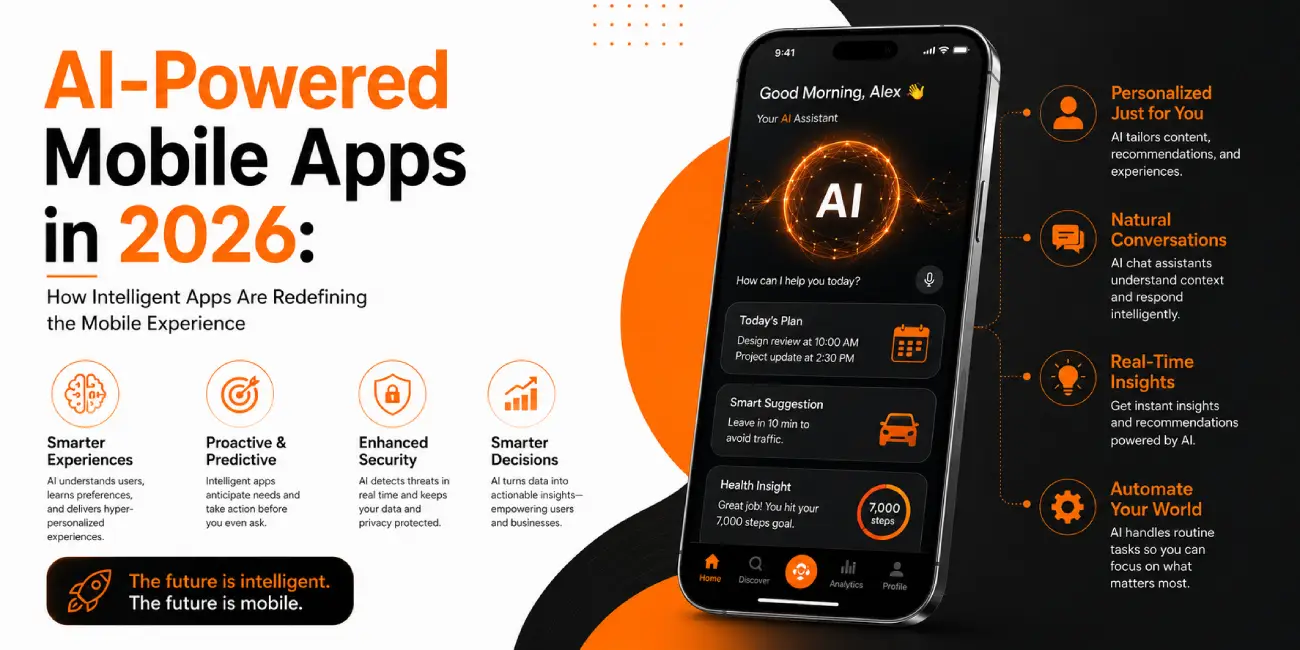
AI-Powered Mobile Apps in 2026: How Intelligent Apps Are Redefining the Mobile Experience
Ready to build your AI-powered mobile app? Contact Strive DigiTech for a free consultation.
Introduction
Not long ago, a mobile app was considered successful if it loaded quickly and didn't crash. Today, that bar has been raised beyond recognition. In 2026, users expect their apps to know them — to anticipate what they need before they ask, adapt to their preferences in real time, and deliver experiences that feel less like software and more like a conversation with an intelligent assistant.
The driving force behind this transformation? Artificial Intelligence. AI has evolved from a back-end novelty to the beating heart of mobile app development. It is reshaping everything: how apps are built, how they behave, how they learn, and how they generate value for businesses.
According to industry data, worldwide mobile app downloads are expected to surpass 181 billion in 2026, with Android leading due to broader global adoption and iOS commanding higher per-user spend. Yet the real story is not in the numbers of downloads — it is in the nature of the apps being downloaded. Users are increasingly choosing apps that are smarter, faster, and more contextually aware.
In this blog, we explore the defining trend of mobile app development in 2026: the rise of AI-powered apps. We look at what this trend means in practical terms, which technologies are enabling it, how businesses across industries are benefiting, and what development teams — including Strive DigiTech — are doing to build apps that are truly intelligent.
Why AI Is the Defining Trend in Mobile App Development
Every year brings its share of buzzwords in the technology industry. But AI in mobile apps is not a trend in the superficial sense — it is a structural shift in how mobile software is conceived, designed, and deployed.
Generic experiences are effectively dead. As leading analysts put it, AI-driven personalization is no longer optional — it is a requirement. Mobile apps in 2026 are expected to anticipate user behaviour, dynamically adjust content, and deliver predictive interactions without users having to configure anything manually.
Several converging factors have brought us here:
- On-device AI chips: Modern smartphones from Apple and Qualcomm now include dedicated Neural Processing Units (NPUs) capable of running machine learning models entirely on-device, without sending data to the cloud.
- Mature ML frameworks: Tools like TensorFlow Lite, Core ML, and MediaPipe have made it far simpler for developers to embed intelligent features without needing a team of data scientists.
- User expectations: Having experienced AI in recommendation engines (Netflix, Spotify, YouTube), users now expect the same intelligence from banking apps, fitness trackers, retail apps, and beyond.
- Competitive pressure: In crowded app markets, intelligence is becoming the primary differentiator. Two apps offering the same core function — say, a food delivery or travel booking app — will be distinguished almost entirely by how well they know and serve the individual user.
Core AI Capabilities Reshaping Mobile Apps
1. Hyper-Personalisation at Scale
The most visible expression of AI in mobile apps is personalisation. In 2026, this goes far beyond showing users content they have previously liked. AI models now analyse behavioural patterns, location data, time of day, device usage habits, and even typing speed to build rich user profiles — and then use those profiles to customise virtually every aspect of the app experience.
Home screens rearrange themselves based on what the user is likely to need next. Notifications are sent at the exact moment the user is most likely to engage. Product recommendations are not based on broad demographic categories, but on the specific individual's purchase history, browsing context, and even emotional state inferred from interaction speed.
For businesses, this level of personalisation translates directly into higher retention rates, longer session times, and increased conversion. For users, it means apps that feel genuinely useful rather than generic.
2. Generative AI Features
The integration of generative AI into consumer mobile apps has been one of the most significant developments of the past two years. Apps can now generate content, images, summaries, and responses on the fly — not as a gimmick, but as a core product feature.
In productivity apps, this means AI that drafts emails, summarises documents, and suggests meeting agendas. In creative apps, it means image generation, video editing assistance, and style transfer. In customer service applications, it means conversational AI that handles complex queries with nuance and context — reducing the burden on human agents while dramatically improving response quality.
For development teams, integrating generative AI requires careful thought around latency, cost, and user trust. The best implementations in 2026 are those where AI assistance feels natural and unobtrusive — a helpful co-pilot rather than an intrusive overlay.
3. Natural Language and Voice Interfaces
Voice-first interfaces have matured considerably. Where early voice assistants struggled with accents, context, and multi-step instructions, modern voice AI — powered by large language models running on-device or via low-latency cloud APIs — handles natural conversation with remarkable accuracy.
In 2026, voice is not just for search queries. It is being used for voice commerce (placing orders, making payments), in-app navigation for accessibility, and hands-free operation in automotive and industrial contexts. Apps built with voice as a first-class interface rather than an afterthought deliver far superior experiences for the growing segment of users who prefer speaking to typing.
4. Predictive Analytics and Intelligent Automation
AI in mobile apps is increasingly proactive rather than reactive. Rather than responding to user actions, apps now anticipate them. A fitness app detects that a user has been sedentary longer than usual and prompts them with a tailored workout. A financial app identifies an unusual transaction pattern and flags it before the user even opens the app. A travel app notices the user is near an airport and automatically pulls up their upcoming booking.
This predictive layer — powered by machine learning models trained on historical usage data — is what separates truly intelligent apps from those that simply have a chatbot bolted on. Building it requires careful data architecture, model training pipelines, and a thoughtful approach to user privacy.
The Infrastructure Enabling AI-Powered Apps
5G: The Speed Layer
AI-powered apps, particularly those relying on cloud-based inference or real-time data processing, require bandwidth and latency that previous network generations could not reliably provide. With 5G networks now reaching critical mass in major global markets, this constraint has largely been removed.
The low latency of 5G enables seamless video streaming, real-time augmented reality overlays, and live AI inference — all simultaneously. For app developers, this means experiences previously confined to high-end gaming or specialised enterprise tools are now viable in consumer apps targeting broad audiences.
Edge AI: Intelligence On the Device
A crucial architectural shift in 2026 is the move toward edge AI — running machine learning models directly on the smartphone rather than sending data to cloud servers. This approach offers significant advantages: it reduces latency to near-zero for AI-driven features, eliminates data transfer costs, and — critically — keeps sensitive user data on the device.
Apps using on-device models for tasks like image recognition, sentiment analysis, and language processing can deliver intelligent features even without an internet connection. This makes AI-powered functionality viable in regions with unreliable connectivity and in use cases — such as healthcare and finance — where data privacy is paramount.
Privacy-First AI Architecture
The very capabilities that make AI-powered apps compelling — collecting behavioural data, learning individual preferences, predicting actions — also raise legitimate privacy concerns. Regulatory frameworks such as GDPR, India's DPDP Act, and various state-level privacy laws in the US have made privacy compliance non-negotiable.
Leading development teams in 2026 are embedding privacy-enhancing computation directly into their architecture: federated learning (where models are trained on distributed user data without centralising it), differential privacy techniques, and transparent consent frameworks. Users are increasingly savvy about data permissions, and apps that handle data responsibly are rewarded with higher trust and longer retention.
Industry Applications: AI-Powered Apps Across Sectors
The shift toward AI-powered mobile apps is not happening uniformly across all industries. Some sectors are further ahead, driven by clear ROI and user demand. Here is how intelligent apps are transforming key verticals:
Healthcare and Wellness
Health apps in 2026 go far beyond step counters. AI-powered diagnostic assistance, symptom checkers using large language models, personalised medication reminders, and mental wellness tools that adapt to detected stress patterns are becoming standard features. Wearable integration means these apps receive continuous biometric input, enabling genuinely proactive health management.
Financial Services
Fintech apps are leveraging AI for fraud detection, personalised investment recommendations, spend analysis, and conversational banking interfaces. AI models process transaction histories to offer genuinely contextual financial advice — not generic tips, but specific insights based on the individual user's actual financial behaviour.
E-Commerce and Retail
The gap between online and in-store shopping is narrowing through augmented reality and AI personalisation. Retail apps now let users visualise furniture in their actual rooms, try on clothing virtually, and receive recommendations that account for body type, style history, and current trends. AI-powered search understands natural language queries — a user can type 'something comfortable for a beach wedding' and receive genuinely relevant results.
Education and EdTech
Adaptive learning platforms use AI to identify each student's strengths, weaknesses, and optimal learning pace — then dynamically adjust the curriculum. AI tutors provide instant, contextually appropriate feedback. The result is a learning experience that rivals personalised human instruction at a fraction of the cost, accessible from any smartphone.
Logistics and Field Operations
For businesses with mobile workforces, AI-powered apps are transforming operational efficiency. Route optimisation that accounts for real-time traffic and delivery constraints, predictive maintenance alerts for field equipment, and AI-assisted quality inspection using smartphone cameras are all live in production environments in 2026.
Development Approaches: Building AI-Powered Apps in 2026
Cross-Platform Development
Building separate native apps for iOS and Android used to be the only credible path for high-performance applications. In 2026, cross-platform frameworks — particularly Flutter — have narrowed the gap sufficiently that most businesses can achieve native-quality experiences from a single codebase.
This matters enormously for AI-powered apps because the data infrastructure, machine learning pipelines, and business logic — typically the most complex parts of an intelligent app — can be built once and deployed everywhere. Platform-specific shells handle UI nuances and native integrations, keeping the intelligent core consistent across devices.
AI-Assisted Development
Ironically, AI is also transforming how apps are built, not just what they do. Development teams are using AI coding assistants to accelerate implementation, generate boilerplate, and identify bugs before they reach production. The result is faster development cycles, higher code quality, and more time for developers to focus on the genuinely complex architectural decisions that AI cannot (yet) make.
Low-Code Platforms with AI Integration
Gartner projects that by 2026, low-code development tools will account for 75% of new application development, up from 40% in 2021. These platforms now offer built-in AI components — natural language processing modules, recommendation engines, image recognition capabilities — that can be integrated without writing ML code from scratch.
For businesses, this means faster time-to-market and the ability to validate AI-powered ideas without committing to full-scale custom development upfront. For experienced development firms, it means using these platforms as accelerators while building custom intelligence on top.
Challenges to Building Intelligent Apps Well
The opportunities presented by AI-powered mobile apps are substantial — but so are the pitfalls. Building intelligent apps that actually work in production, and that users trust, requires navigating several genuine challenges:
- Data quality and volume: Machine learning models are only as good as the data they are trained on. Apps with limited user bases face a cold start problem — insufficient data to personalise effectively early in the product lifecycle. Solving this requires careful use of synthetic data, transfer learning from pre-trained models, and thoughtful onboarding flows that gather preference signals efficiently.
- Model explainability: When an AI system makes a recommendation or takes an automated action, users increasingly want to understand why. Building apps where AI decisions are interpretable — not black boxes — is both an ethical imperative and a trust-building strategy.
- Battery and performance: On-device AI inference can be computationally intensive. Poorly optimised models can drain batteries and degrade app performance, undermining the very experience they are meant to enhance. Careful model compression, quantisation, and benchmarking are essential.
- Avoiding AI washing: Not every app feature needs AI. There is a real risk of adding AI for its own sake — creating complexity and cost without delivering genuine value. The best development teams in 2026 are those who ask hard questions about where intelligence genuinely improves the user experience, rather than adding it indiscriminately.
What This Means for Businesses
For business leaders considering mobile app investment in 2026, the question is no longer whether to incorporate AI — it is how to do so strategically.
Start with a clear value hypothesis. Identify the specific user problem that AI solves better than a traditional rule-based approach. Then validate that hypothesis with real users before committing to full-scale development. The biggest risk to any app's success is building something nobody needs — technical complexity ranks far lower.
Choose the right development partner. Building AI-powered apps requires expertise that spans mobile engineering, machine learning, data architecture, and UX design. These disciplines need to work in close coordination — teams that operate in silos produce apps where the AI feels bolted on rather than integrated.
Think long-term. AI-powered apps improve over time as they accumulate more user data and as underlying models are retrained. This requires an ongoing investment in data infrastructure, model monitoring, and product iteration — not a one-time development project. Businesses that think of their app as a living product rather than a completed deliverable will reap compounding returns.
How Strive DigiTech Builds AI-Powered Mobile Experiences
At Strive DigiTech, we have been at the forefront of mobile app development in India, helping businesses across industries build applications that are not just functional, but genuinely intelligent.
Our approach to AI-powered app development is grounded in three principles:
- User-centric design first: We believe intelligence should serve the user, not impress reviewers. Every AI feature we build is designed around a specific, validated user need — and tested rigorously to ensure it improves rather than complicates the experience.
- Scalable technical architecture: We build apps with growth in mind. Data pipelines, model serving infrastructure, and API design are architected from day one to scale — so that as user numbers and data volumes grow, the app's intelligence grows with them.
- Ongoing partnership: Our relationship with clients does not end at launch. We provide continuous support, model retraining, feature iteration, and performance monitoring — because AI-powered apps are never truly finished.
Whether you are a startup looking to validate a product idea or an established business ready to transform your customer experience through mobile, we bring the technical depth and strategic thinking to make it happen.
Conclusion
The mobile app landscape in 2026 is defined by intelligence. The apps that users return to, recommend, and build their daily routines around are the ones that know them — that learn from them, adapt to them, and consistently deliver value that feels almost uncannily relevant.
AI is no longer a differentiator that gives early adopters an edge. It is rapidly becoming table stakes — the baseline expectation that users bring to every app they download. Businesses that move decisively to build intelligent mobile experiences will compound their advantage over time as their models improve and their user data deepens. Those that wait risk building apps that feel dated before they even launch.
The future of mobile app development is smart, secure, personalised, and proactive. It is an exciting moment to be building — and the businesses that embrace it with the right strategy and the right partners will define the next generation of mobile experiences.